|
Suri
and Huacaya
 |
 |
| |
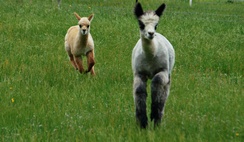
The more common
huacaya alpacas have soft, crimpy
fiber giving them a fluffy appearance.
|
The two types of alpacas
are huacaya and suri.
Both have fleeces that are soft and
virtually free of guard hair. Ninety-five
percent of alpacas are huacaya, whose
crimpy fiber grows perpendicular to
the skin and gives them a "fluffy"
appearance. When you handle a raw huacaya
fleece, it will feel warm and inviting
to the touch. A premium huacaya fiber
is so soft, it feels like you are touching
a cloud.
The lustrous, straight
fiber of the suri fleece hangs down
in "dreadlocks," giving the
suri alpaca an entirely different appearance.
A high-quality suri coat is so lustrous,
it glistens in the sunlight and feels
like cool silk to the touch. There is
nothing like the elegant look of a suri
moving in full fleece; it's like watching
the wind blow across a perfect meadow.
Fibers of both types are considered
luxury fibers in the textile trade because
of their unique qualities. Tuis or yearling
alpacas provide the finest fleeces.
Depending upon its weight, color, quality,
and cleanliness, an entire prime alpaca
fleece can command $150 to $400.
 |

|
|
The more rare
suri alpaca is distinguished by
silky, lustrous fiber that drapes
the head and body hanging to the
ground.
|
|
Harvesting alpaca fiber
has many rewards, and there are new
and exciting opportunities for breeders
to sell or process their fleeces into
finished, spun goods. As with the actual
animal, many qualities of a fleece are
subjective, and fiber shows (which judge
alpaca fiber) now generally accompany
alpaca halter shows (which judge physical
conformation).
Centuries ago, the powerful Inca
empire focused its many religious and
ritualistic practices around the llama
and alpaca. In Incan culture, alpaca
fiber was reserved for royatly. The
Incan term aluascay refers to
cloth woven from llama and guanaco fiber
and worn by commoners. Gami,
refers to alpaca cloth worn by high
ranking officials and nobility, and
cumbi (probably meaning exclusive
or special) referred to vicuna cloth.
In their drive to acquire precious metals
during the Conquest, the Spanish measured
the wealth of the Inca empire by its
gold and silver. To the Inca, status
and wealth were in cloth. In all of
human history, there may have been nothing
like the Incan obsession with fine cloth.
Fabric, often made of alpaca, was the
medium in which Inca society defined
it's essence. The entire civilization
with its ingenious eye for detail and
organization, put its best efforts into
fine fiber and beautiful textiles.
 |
|
 |
|
This close up
of a huacaya's fleece clearly
shows the "zig-zag"
crimp that originates from the
skin, giving the fleece its
fluffy quality.
|
|
This close up
of a suri's fiber shows the
absence of crimp; note that
even in a dusty fleece such
as this, a quality suri still
has lustre near the skin.
|
|
photos courtesy
of Ameripaca
|
|