|
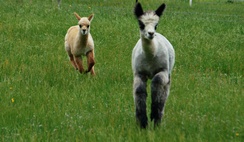
What's
the difference between an alpaca and
a llama?
 |
 |
| |
The much larger
llama is easily
distinguished by its banana-shaped
ears, impending size, and
coarser fiber. (Photo by Jennifer
Clark)
|
Many people are confused
about the differences between alpacas
and llamas. The photo below of an adult
llama and an adult suri alpaca should
clear up some of the confusion. The
average llama is roughly twice the size
of the average alpaca. There are differences
in the body and head also, especially
the shape of the ears.
While the alpaca has been carefully
bred for over 6,000 years as a luxury
fiber-producing animal, the llama was
bred as a pack animal. Its purpose has
traditionally been to carry packs in
mountainous terrain. The llama has coarse
guard hair which protects it's fine,
inner coat of fleece from the chafing
of the pack on its back.
Alpacas do not have guard hair in
the prime fleece of this "blanket" area.
Despite its much larger size, the llama
produces far less fleece per animal
than the alpaca. The llama shown here
has not been shorn; the alpaca shown
here was shorn a few months earlier.
The fleece of the alpaca is so dense
that the animals could not remain healthy
in the heat of the summer with their
fleeces unshorn.
 |

|
The smaller, more readily handled
alpaca has straight ears and
a much softer fiber devoid of
guard hairs. (Photo by Armstrong
Studio)
|
|
In addition to its packing use, the
llama makes a very good guard animal
for alpacas, sheep and other small livestock.
Llamas and alpacas can interbreed and
produce live, fertile offspring, but
this offspring would not be either as
strong as a true llama nor have as lovely
a fleece as a true alpaca, so this "intermediate"
animal would not be very useful. New
research has confirmed that, while the
alpaca was bred by the Incas out of
a Vicuna ancestor, the llama was bred
by the Incas from a Guanaco ancestor.
All four of these animals are members
of the camel family, but the rare and
endangered Vicuna is famous as the animal
with the finest fleece in the world.
|